"At the end of this solemn Celebration, in which we have meditated upon the Passion of Christ, I wish to remember the late Archbishop of Mosul of the Chaldeans, Paulos Faraj Rahho, who died tragically a few days ago. His beautiful testimony of faithfulness to Christ, to the Church, and to his people, whom he had not wanted to leave, despite numerous threats, prompts me to raise a strong and heartfelt cry: enough with the bloodshed, enough with the violence, enough with the hatred in Iraq!Benedict XVI - Angelus (March 16, 2008)
Showing posts with label Christianity. Show all posts
Showing posts with label Christianity. Show all posts
2008-03-16
Enough!
From RORATE CÆLI:


2008-02-28
A Fifth of the Good Stuff
Mike Aquilina - on his The Way of the Fathers blog - today offers us a translation of the fifth and concluding part of Pope Benedict's weekly meditations on St Augustine. (Apparently, in Rome, "there were so many pilgrims that the overflow had to be gathered into St. Peter's!") As always with this great pastor and theologian, there is much of an inspirational nature to consider:
Today I would like to conclude my presentation of St. Augustine. After having dwelt on his life, his works, and some aspects of his thought, I wish to go back today to his interior life which made him one of the greatest converts in Christian history.
To this interior experience, I particularly devoted my reflections during the pilgrimage I made to Pavia last year to venerate the mortal remains of this Father of the Church. I wanted to express the homage of the entire Catholic Church but also to show my personal devotion and acknowledgment of a figure to whom I feel very much connected for the part that he has played in my life as a theologian, priest and pastor.
Even today we can retrace the experiences of St. Augustine, thanks above all to his Confessions, written in praise of God and which originated one of the most specific literary forms of the West, the autobiography, that is, a personal expression of one's consciousness about oneself.
Whoever reads this extraordinary and fascinating book, which is still widely read today, will easily realize that Augustine's conversion was neither sudden nor fully realized immediately, but that it could be better defined as a true and proper journey, which remains a model for each of us.
This itinerary certainly culminated in his conversion and baptism, but it did not end on that Easter Vigil of 387 when the African rhetorician was baptized by Bishop Ambrose in Milan.
Augustine's journey of conversion, in fact, continued humbly until the end of his life, so that one can say that its various stages - one can easily distinguish three - made up a unique act of conversion.
St. Augustine was a passionate searcher for the truth - he was from the very beginning and all his life. The first stage of his journey of conversion was his progressively coming close to Christianity. Actually, he received a Christian education from his mother Monica, to whom he was always closely linked, and although he led an undisciplined life in his youth, he always felt a profound attraction to Christ, having drunk love for the name of the Lord with his mother's milk, as he himself underscored (cfr Confessiones, III, 4, 8).
But philosophy, too, especially Platonic, contributed to bring him closer to Christ by showing him the existence of the Logos, creative reason. The philosophers' books showed him that there was Reason, from which the whole world sprung, but they did not tell him how to reach this Logos which seemed so remote.
Only reading about the faith of the Catholic Church in St. Paul's letters revealed the truth fully to him. This experience was synthesized by Augustine in one of the most famous pages of the Confessions: He recounts that, in the torment of his reflections, he retired to a garden, where suddenly he heard a child's voice which repeated to him a lullaby he had never heard before, "Tolle, legge, tolle, legge" (Take and read, take and read) (VIII, 20,29).
He then remembered the conversion of St. Anthony Abbot, the father of monasticism, and with great urgency, he turned to the Pauline epistolary which he had in his hands earlier, opened it, and his glance fell on the passage from the Letter to the Romans where the Apostle exhorts the Romans to abandon the ways of the flesh and "put on the Lord Jesus Christ" (13, 13-14).
He understood that at that moment, those words were addressed to him, that it came from God through the Apostle, and showed him what to do right then. Thus, he felt the shadows of doubt dissolve and he found himself finally free to give himself completely to Christ: "You converted my being to you", he commented (Confessiones, VIII, 12,30). This was his first and decisive conversion.
The African rhetorician reached this fundamental stage of his long journey, thanks to his passion for man and for the truth, a passion which brought him to look for God, great and seemingly inaccessible. Faith in Christ made him understand that God, apparently so remote, was really not. In fact, that he had made himself close to us by becoming one of us.
In this sense, faith in Christ fulfilled Augustine's long search along the path of truth. Only a God who made himself "tangible", one of us, was a God to whom one could pray, for whom and with whom one could live. But it is a way to follow with courage as well as humility, opening us to a permanent purification of which each of us is always in need.
With that Easter Vigil Baptism of 387, as we said earlier, Augustine's journey was not done. He returned to Africa where he retired with a few friends to dedicate themselves to a life of contemplation and study. This was the dream of his life. He was called to live totally for the truth, with the truth, in friendship with Christ who is the Truth.
It was a beautiful dream that lasted three years, until when, against his wishes, he was consecrated a priest in Hippo, destined to serve the faithful, continuing to live with Christ and for Christ, but in the service of all.
This was very difficult for him, but he understood from the beginning that only by living for others, and not only for his private gratification, could he really live with Christ and for Christ. Thus, renouncing a life of pure meditation, Augustine learned, often with difficulty, to offer the fruit of his intelligence for the benefit of others.
He learned to communicate his faith to simple people, and living that way in what became his city, he carried out tirelessly a generous and onerous service that he described in these words in one of his beautiful sermons: "To preach continuously, discuss, reiterate, edify, be at the disposal of everyone - it is an enormous responsibility, a great weight, an immense effort" (Serm. 339,4).
But he took this weight on himself, understanding that this way, he was closest to Christ. To understand that one reaches others with simplicity and humility was his true and second conversion.
But there is a third stage in the Augustinian journey, a third conversion: that which brought him every day of his life to ask God's forgiveness. Initially, he had thought that once he was baptized - in a life of communion with Christ, in the Sacraments, in the celebration of the Eucharist - he would attain the life proposed in the Sermon on the Mount: the perfection given in Baptism and reconfirmed in the Eucharist.
In the latter part of his life, he understood that what he had said in his first preachings about the Sermon on the Mount - that is, that we Christians would thereafter live that ideal permanently - was wrong. That only Christ himself was the true and complete realization of the Sermon on the Mount.
We are all always in need of being "washed" by Christ, who washes our feet, and to be renewed by him. We need permanent continuing conversion. Up to the end we need the humility to recognize that we are sinners on a journey, until the Lord gives us his hand conclusively and introduces us to eternal life. In such an attitude of humility, lived day after day, Augustine died.
This attitude of profound humility before the one Lord Jesus introduced him also to the experience of intellectual humility. Augustine, in fact, who is one of the greatest figures in the history of ideas, wished during his final years to place all his numerous works under lucid critical examination.
That was the origin of Retractiones (Revisions) which, in this way, placed his theological thinking, which was truly great, within the humble and holy faith of what he called simply with the name Catholic, that is, the Church.
"I understood," he wrote in this very original book (I, 19,1-3), "that only one is truly perfect, and that the words of the Sermon on the Mount are completely realized only in one - in Jesus Christ himself. The whole Church, instead - all of us, including the Apostles - must pray every day: forgive us our sins as we forgive those who sin against us."
Converted to Christ, who is truth and love, Augustine followed him the rest of his life and has become a model for every human being, for all of us in search of God.
That is why I wished to conclude my pilgrimage to Pavia by symbolically offering to the Church and to the world, at the tomb of this great lover of God, my first encyclical, Deus caritas est.
In fact, the encyclical owes a great deal, especially in the first part, to the thought of St. Augustine. Even today, as in his time, mankind needs to recognize, and above all, to live, this fundamental reality: God is love, and the encounter with him is the only response to the anxieties of the human heart. A heart that is inhabited by hope, perhaps still obscure and even unconscious in many of our contemporaries, but which for us Christians, already opens the future, such that St. Paul wrote, "in hope we are saved" (Rom 8,24).
I dedicated my second encyclical, Spe salvi, to hope, and even that owes a great deal to Augustine's thoughts and his encounter with God.
In a very beautiful text, Augustine defined prayer as the expression of desire, and stated that God responds by opening up our hearts to him. On our part, we should purify our desires and our hopes in order to receive the kindness of God (cfr In I Ioannis, 4, 6). Only this, in fact, opening us up to others, saves us.
Let us pray therefore that in our life we may be granted to follow everyday the example of this great convert, encountering like him, in every moment of our life, the Lord Jesus, the only one who saves us, purifies us, and gives us true joy and true life.
2008-02-26
A Hierarchical Word on End-Times Fanatics
From Western Orthodoxy:
The real meaning of the English word "Gospel" is good news, but one can find those who are more attracted to the Bad News Gospel. You can find religious circles more interested in the anti-Christ than in Christ, more interested in the number 666 than the Holy Trinity. This is a fear-driven, bad news orientation. Where such a mentality thrives, the Christian contribution to society is meager. Where faith, hope and love flourish, transformation occurs. Faith changes life. If life doesn't change, clearly there is no faith. St. John Chrysostom, preaching to perhaps 400 people in Antioch, told them, "If all of you were Christians, there would be no more pagans in the world." If you want to understand how Christianity spread so rapidly in the early centuries, it was because Christians were Christian...
This is our tragedy because more than ever the world needs the light of Christ, the genuine light.
-- Metropolitan JOHN [Pelushi] of Korça, Albanian Orthodox Church.
2008-02-22
Quote of the Day - Fulton J. Sheen
From Dawn Eden's The Dawn Patrol via Father Gregory Jensen's Koinonia:
"One way to make enemies and antagonize people is to challenge the spirit of the world. The world has a spirit, as each age has a spirit. There are certain unanalyzed assumptions which govern the conduct of the world. Anyone who challenges these worldly maxims, such as, 'you only live once,' 'get as much out of life as you can,' 'who will ever know about it?' 'what is sex for if not for pleasure?' is bound to make himself unpopular...
"To marry one age is to be a widow in the next. Because [Jesus Christ] suited no age, He was the model for all ages."
— Fulton J. Sheen, Life of Christ
2008-02-13
Niebuhr on Liberal Protestantism
This brought a [knowing] smile to my face. From orrologion:
...In the 1930's, Reinhold Niebuhr famously observed that liberal Protestantism preached "a God without wrath who brought men without sin into a kingdom without judgment through the ministrations of a Christ without a cross."
2008-02-09
The Justice - and Mercy - of God
Pope Benedict XVI speaking at a meeting with the Parish Priests and Clergy of Rome (February 7, 2008) - from RORATE CÆLI:
We all desire a fair world. But we cannot repair all the destructions of the past, all the people unjustly tormented and killed. Only God himself can create justice, which must be justice for all, even for the dead. And, as Adorno, a great Marxist, says, only the resurrection of the flesh, which he considers unreal, could create justice.
We believe in this resurrection of the flesh, in which not all will be equal. It is common to think today: whatever is sin, God is magnificent, he knows us, therefore sin does not matter, in the end God will be nice with everyone. It is a beautiful hope. Yet, there is justice, and there is true guilt. Those who have destroyed man and earth cannot suddenly sit beside their victims at the table of God. God creates justice. We must have this present.
It seemed thus important for me to write also this text [Spe Salvi] on purgatory, which for me is such an obvious truth, so clear and also so necessary and consoling that is cannot be forgotten. I tried to say: perhaps there are not so many who have destroyed themselves thus, who are forever incurable, who do not have any element left upon which the love of God may rest, who do not have in themselves a minimum capacity for loving. This would be hell.
On the other hand, they are certainly few - or at least not many - those who are so pure as to be able to immediately enter in the communion with God. Very many of us hope that there be something curable in us, that there be a final desire to serve God and to serve men, of living according to God. But there are so many wounds, so much filth. We have the need of being ready, of being purified. This is our hope: even with so much filth in our souls, in the end the Lord gives us the possibility, cleanses us finally with his goodness which comes from his cross. He thus renders us capable of being forever with him. And therefore heaven is hope, it is justice finally realized. And he gives us also the criteria for living so that this [present] time may also be, in a certain way, heaven, a first light of heaven.
Wherever men live according to these criteria, a speck of heaven appears in the world, and this is visible. It seems to me also an evidence of the truth of faith, of the need to follow the way of the commandments, of which we should speak more often. They are truly road signs and show us how to live well, how to choose life. Therefore, we must also speak of sin and of the sacrament of forgiveness and reconciliation. A sincere man knows that he is guilty, that he should start anew, that he should be purified. And this is the wonderful reality which the Lord offers us: there is a possibility for renewal, of being new. The Lord starts anew with us and we can thus start anew also with the others in our life.
2008-02-08
What means this word Catholic?
An interesting perspective - and one with which [I think] I largely agree - from Father Robert Hart (a "traditional" Anglican priest in Australia) at The Anglican Continuum:
"Whosoever will be saved, before all things it is is necessary that he hold the Catholic Faith. Which Faith except everyone do keep whole and undefiled, without doubt he shall perish everlastingly. And the Catholic Faith is this: That we worship one God in Trinity, and Trinity in Unity, neither confounding the Persons, nor dividing the Substance." - Opening of the Athanasian Creed
"I believe in the Holy Ghost: The holy Catholic Church; The Communion of Saints: The Forgiveness of sins: The Resurrection of the body: And the Life everlasting. Amen." - From the Apostle's Creed "And I believe one Holy, Catholic and Apostolic Church." - From the Creed called Nicene (i.e. Nicene-Constantinopolitan). From the usage of the word "Catholic" in ancient times we see that it speaks, above all, of the Church and of the Faith of that Church (namely, its doctrine). This word is used by everybody in Christianity, and is the property of no one denomination. The churches under the Pope, the Roman Catholic and the Byzantine (Eastern Rite) Catholic Churches, have been associated with this word in a denominational sense, which causes some confusion. It leads to the bad argument of Cardinal Newman, that if, in any town you asked to be taken to the Catholic Church, you would be taken to the Roman Catholic Church, which makes it, alone, the real thing. Actually, it means the cab driver reads the signs on the front of church buildings, and it proves only that he is literate, at least to that degree. Beyond that, it proves nothing. It offends some Roman Catholics that others, Anglicans, the Orthodox, the Polish National Catholic Church, sometimes even the Byzantine Catholic Churches, openly use the word "Catholic" as their own property. But, the use of this word by others is not intended as a gesture of disrespect for Roman Catholics, and neither is it used to seduce the naive of their flock into a wolf's lair- the old "bait and switch." It is, rather, respect for what we know ourselves to be, and for what we believe and teach (and the capital "C" is used in the Book of Common Prayer because, by usage, "Catholic" is a name of the Church. We need not use the lower case). We believe in the Catholic Church, and furthermore, we believe the One, Holy Catholic and Apostolic Church (i.e. we believe what it teaches and the Truth to which it testifies). Each of us says these words in the first person: "I believe." This is not a denominational word, but a credal word. It is a word that exists in the persuasion of the mind, the depth of the heart and the power of conscience. It is theological, not cultural. And, as each person says it liturgically, by the rule of Lex Orandi Lex Credendi, each one rightly takes it as his own. We do not say we believe it as someone else's property, removed from us. We do not claim to believe a church that we do not belong to. We do not confess a Faith that we cannot own. We intend no offense or disrespect, and certainly no deception; but, we will not give up this word or what it means, for it belongs to us just as surely as Christ himself is our Lord. When we speak of branches of the Church, we do not intend even so much as to imply, let alone assert, that outward and apparent division among God's people is the plan and purpose of God. It is not of the nature of the Church that it exists in divided branches, rather it is symptomatic of the current state of all mankind this side of our promised immortality. Partly, divisions are due to the sin and foolishness of fallen man, and the problem of division was addressed long ago by St. Paul, writing to the Church in Corinth.
"For it hath been declared unto me of you, my brethren, by them which are of the house of Chloe, that there are contentions among you. Now this I say, that every one of you saith, I am of Paul; and I of Apollos; and I of Cephas; and I of Christ" (I Corinthians 1:11, 12). He did not say, "the true Church among you are those who say 'I am of Cephas.' " Neither did he say, "the true Church among you are both those who say 'I am of Cephas' and 'I am of Paul'- the double foundation o' foolish Corinthians." Even those who saw themselves as separate because they were better than the others, those who said "I am of Christ," were rebuked by the Apostle for their divisiveness. Paul attributed all of this to childishness and carnality (I Corinthians 3:3, 4). The idea that these divisions were God's plan, or that one party should be favored as right, and the others condemned as wrong, was not considered by the Apostle. Nor would he consider it today.
But, current divisions into which the Church has been driven are historical, not the fault of anyone living, and they are beyond the power of anyone simply to remedy (therefore I said "partly" above). The Anglican view is that both Rome and Orthodoxy are the One True Church, and so are we. In fact, we agree with The Catechism of the Catholic Church where it says that everyone who is baptized belongs to the Church (I Corinthians 12:13). Division is not the plan of God, but he has provided what is needed for the salvation of each soul through the Church, nonetheless. Furthermore, the divisions exist even among members of the same Communions. In the United States each major city has Orthodox Churches of various jurisdictions, answering to different bishops under different Patriarchates. And, before anyone begins to crow triumphantly, let it be remembered that in addition to the Roman (as in Latin Rite) Catholic bishop, in any given city we find any number of Byzantine Catholic bishops (and often feelings of strife exist between the Byzantine Catholics and the Latin Rite, or Roman, Catholics). Nonetheless, people in these outwardly divided bodies, none of whom created this work of history, are part of the Body of Christ and belong to one Church. The Church Militant is visible, and, for the present, visibly divided.
Common Property
It was never possible, really, for the Gospel to be preached in all nations without the Church having within it differences of culture and language. Therefore, unity has had obstacles, some of them very sad. The division of the Coptic Christians from the rest of the Church as early as the Council of Chalcedon was not about real heresy, but about perceived heresy due to a simple, or rather complicated, misunderstanding of the Greek word, ὑπόστᾰσις (hypostasis). Differences of culture have also caused problems of misunderstanding. But, for the most part, the Church was unified for a thousand years, and only in recent decades (beginning in the 1960s) have the ancient Patriarchates of Rome and Constantinople approached each other in charity with a view to reconciliation. But, they remain divided.Our common property, nonetheless, is the Apostolic Succession, both as an unbroken line of orthodox teaching, and as a sacramental link through our bishops to the Apostles and the Incarnate Christ, the Risen Christ Who breathed on them the Holy Spirit. This is the Tradition that includes all of our Scriptures with the key that unlocks their true meaning, the gift of the Holy Spirit. Our fathers died and were imprisoned during the persecution by the Empire, and they fought for the Faith once delivered to the saints (Jude 3) by defending and clarifying that Faith, seen most obviously in the Ecumenical Councils. They preached in times and places of peril to pagans of many tongues and strange customs, overcame opposition, and established the Church of Christ in many lands where demonic spirits demanded sacrifice to false gods, tearing down those shrines to build new holy places for the preaching of the Gospel and the administration of the sacraments.
The mark of the Holy Spirit is the revelation of Jesus Christ that we find as their collective teaching, and the Gospel that was the testimony of the Apostles and other martyred eyewitnesses. The teaching has its universal and complete uniformity of meaning because of the Holy Spirit, who creates unity of mind that cuts through all the chaos of human fallenness, across times and across continents. This is "what has been believed always, everywhere and by all" clearly and obviously in a way that defies the apparent disunity of temporary polities.
This is what we mean by "the Catholic Church" and "the Catholic Faith." It is our common possession.
2007-12-28
The Holiness of the Church
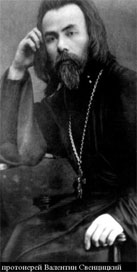 Can inadequacies of individual people sully the holiness of the Church?
A partial answer to that question was given by Archpriest Valentin Sventsitsky (1882-1931), a remarkable pastor and confessor, who suffered a great deal at the hands of the atheist regime. The following is an excerpt from a homily given by Fr. Valentin in the 1920s, during an awful time of persecution against the Russian Church:
Inadequacies in the Church are not just a contemporary manifestation; they have always existed.
It is enough but to recall the words of St. Gregory the Theologian, ‘Faith in God has perished.' It is enough but to recall the words of St. John Chrysostom, who in a talk on the Epistle to the Corinthians said, ‘In the Church, we only have a plethora of fond memories that both in times past and now people would gather together to chant. However, before, when people gathered together to chant, there was oneness of mind, while now you would be hard put to find even one person who would be of one mind with you.'
And this used to be said then, at a time when some of the Nicene Fathers were still alive, when Athanasios the Great had just reposed, when Basil the Great, Gregory the Theologian, and John Chrysostom were alive.
But what does this mean?
It means only that as the result of human weaknesses and illnesses, the Church on earth has many inadequacies.
Can transgressions of individual people shake the holiness of the Church? What a temptation, what a great misunderstanding is expressed if I should leave the Church because I have encountered an unworthy pastor, if I should no longer believe in the Church because one or another bearer of grace has made a bad personal impression on me.
The holiness of the Church does not rest in that. It rests in the Mysteries, in the holiness of God's Grace, in all of the good which that Grace has done for men's souls; it rests in that assembly of saints who were saved by that grace, it rests in every truly kind impulse of our souls.
These glorious and holy [things] are what comprise the holiness of the Church. Our sins – our illnesses – are sinful weaknesses that we wash and cleanse in that Holy Church of Christ.
For that reason, let us not be troubled in our personal life by the evil idea that we need not labour when we are weakened by our sins, and likewise let us not, let our faith not, be troubled by doubts in the holiness of the Church whenever we see some inadequacy or other in the earthly Church.
Our recognition of our sins should evoke in us not despondency, but only ever greater effort to do the Lord's work. Recognition of inadequacies in church life should bring about not estrangement from the Holy Church, but even greater love for it, and a desire to serve for the good of the Church.
Archpriest Valentin Sventsitsky
Link to original
Can inadequacies of individual people sully the holiness of the Church?
A partial answer to that question was given by Archpriest Valentin Sventsitsky (1882-1931), a remarkable pastor and confessor, who suffered a great deal at the hands of the atheist regime. The following is an excerpt from a homily given by Fr. Valentin in the 1920s, during an awful time of persecution against the Russian Church:
Inadequacies in the Church are not just a contemporary manifestation; they have always existed.
It is enough but to recall the words of St. Gregory the Theologian, ‘Faith in God has perished.' It is enough but to recall the words of St. John Chrysostom, who in a talk on the Epistle to the Corinthians said, ‘In the Church, we only have a plethora of fond memories that both in times past and now people would gather together to chant. However, before, when people gathered together to chant, there was oneness of mind, while now you would be hard put to find even one person who would be of one mind with you.'
And this used to be said then, at a time when some of the Nicene Fathers were still alive, when Athanasios the Great had just reposed, when Basil the Great, Gregory the Theologian, and John Chrysostom were alive.
But what does this mean?
It means only that as the result of human weaknesses and illnesses, the Church on earth has many inadequacies.
Can transgressions of individual people shake the holiness of the Church? What a temptation, what a great misunderstanding is expressed if I should leave the Church because I have encountered an unworthy pastor, if I should no longer believe in the Church because one or another bearer of grace has made a bad personal impression on me.
The holiness of the Church does not rest in that. It rests in the Mysteries, in the holiness of God's Grace, in all of the good which that Grace has done for men's souls; it rests in that assembly of saints who were saved by that grace, it rests in every truly kind impulse of our souls.
These glorious and holy [things] are what comprise the holiness of the Church. Our sins – our illnesses – are sinful weaknesses that we wash and cleanse in that Holy Church of Christ.
For that reason, let us not be troubled in our personal life by the evil idea that we need not labour when we are weakened by our sins, and likewise let us not, let our faith not, be troubled by doubts in the holiness of the Church whenever we see some inadequacy or other in the earthly Church.
Our recognition of our sins should evoke in us not despondency, but only ever greater effort to do the Lord's work. Recognition of inadequacies in church life should bring about not estrangement from the Holy Church, but even greater love for it, and a desire to serve for the good of the Church.
Archpriest Valentin Sventsitsky
Link to original
2007-11-22
Which Church Father Are You?
You’re St. Melito of Sardis!
You have a great love of history and liturgy. You’re attached to the traditions of the ancients, yet you recognize that the old world — great as it was — is passing away. You are loyal to the customs of your family, though you do not hesitate to call family members to account for their sins.
Find out which Church Father you are at The Way of the Fathers!
2007-11-08
The Vatican Dogma - Bulgakov
"At present the Vatican dogma is the central problem for the reunion of the church—if the Lord ever reveals to the world this miracle of His mercy. Earlier, at the epoch of the councils of Lyons and of Florence the chief subject of dogmatic disagreement was the dogma about the Holy Spirit, the filioque clause; questions of papal primacy, of using leavened or unleavened bread for the Eucharist, of purgatory and a few others were of secondary importance. In our time, the question about the Holy Spirit has not of course lost either its importance or its difficulty, but in fact, in the believers’ minds, it has ceased to be an impedimentum dirimens (to use V. V. Bolotov’s term) and admits of calm theological discussion, such e.g. as took place in conferring with the Old Catholics. The question about the unleavened bread and the differences between the Eastern and Western liturgies, the significance of which was at one time exaggerated out of all proportion, has also almost lost its importance. Even the question of purgatory and of the new dogma of the Immaculate Conception (in so far as it is dissociated from that of papal infallibility) is comparatively of secondary importance.
"But all these particular disagreements are blotted out by one that is fundamental: by papacy grown strong during the centuries of schism and established as a dogma at the Vatican. This is the basic and decisive divergence between East and West. Catholicism identified itself with papacy and takes its stand upon it; Orthodoxy cannot under any circumstances accept papacy which it regards as a heresy in the doctrine about the church, although it can and should recognize the primacy of the Roman See and honour it as of old. We are thus brought to a deadlock: until Catholicism ceases to be papistry and renounces the Vatican dogma (if only through a new and more exact definition of it)—and this requires a kind of geological cataclysm—there is no way to union with it. But what is impossible to man is possible to God, and all we can do is to trust to Providence which leads us, rules the destinies of the Church, and does that which with men is impossible."
Father Sergei Bulgakov (1929) - Link to entire article
2007-11-06
Paul VI on Christian Unity
"The difficulties in establishing a genuine union between the different Christian denominations are so great as to paralyze any human hope that it can be historically achieved. The breaks that have occurred have ossified, solidified and become institutionalized to such an extent as to make it utopian to attempt to reconstruct a body dependent on Christ as head, and which is, in St Paul's words, well structured. ... The problem of Christian unity seems insoluble, especially because it is a real unity that is sought. One cannot accept any and every illegitimate pluralistic interpretation of the sacred word 'unity.' This need for a genuine unity, when faced with the concrete historical conditions of the various Christian denominations, seems to disappoint any ecumenical hopes: history never goes backward."
From a speech given in January 1978
2007-11-04
Romano Amerio on Ecumenism
"To think that a reconciliation of opposing doctrines can be brought about by pragmatic negotiation is characteristic of worldly minds; it ill becomes philosophers and men of faith."
Iota Unum (1985)
2007-04-08
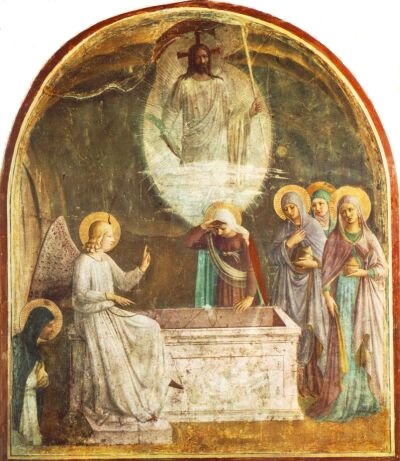
Pascha!
Now let the heavens be joyful.
Let earth her song begin:
Let the round world keep triumph.
And all that is therein:
Invisible and visible.
Their notes let all things blend.
For Christ the Lord is risen
Our joy that hath no end.
(St John of Damascus)
2007-04-06
Good Friday
What Killed Jesus?
An excellent - but gruesome - account on Mike Aqulina's "The Way of the Fathers" blog of the forensic details of Our Lord's Passion and Crucifixion. Some excerpts:
The Gospels say little about the business of crucifixion. “And they crucified him” is all St. Mark offers (15:24), with no word of how it was done or how the cross tortured its victim.
The early Christians offered little more when they recited the Creed: “He was crucified under Pontius Pilate, suffered, died and was buried.”
The Crucifixion comes at the climax of the Christian drama. Yet tradition records the matter as little more than a fact. “They crucified him.” “He was crucified.” History provides no coroner’s report, no painstaking medical reconstruction.
Perhaps our first Christian ancestors could not bear to say any more. They had seen men crucified. They could walk to the outskirts of town if they wanted to count the cost — in blood and pain and humiliation — of their salvation.
Unlike Christians through most of history, we today have not grown up with the experience of public executions and public torture. Still, like the family of any murder victim, we feel the need to know the truth about our Savior and brother — not least because we believe He died for our sake.
Over the past 20 years, a friend of mine, Pittsburgh surgeon Jack McKeating, has applied his professional skills to this problem — reviewing the historical and archaeological evidence in light of recent medical research. Some years back, I interviewed him on the subject for Our Sunday Visitor newspaper.
“Any serious Christian has to take an active interest in the passion of Jesus Christ,” McKeating told me. “Unfortunately, we’re often too dispassionate about it. We tend to think of it in unreal terms, as an abstraction. But it involved a real person who underwent an absolutely brutal experience out of love for me.”
...
Forensic scientists say that the better we know what killed someone, the more likely we are to find out who killed him.
Who killed Jesus? After a decade-and-a-half of study, McKeating doesn’t hesitate to respond.
“I did,” he said. “My sins did.”
2007-01-22
Judgment
Imagine a poor mother obliged to let fall the blade of a guillotine upon the head of her child: such is the good God when He condemns a sinner.
The Curé of Ars
2006-12-25
Merry Christmas!
A Blessed and Joyous Christmas to all celebrating the birth of our Lord God and Saviour on the New Calendar!
 From the Roman Martyrology:
In the 5199th year of the creation of the world, from the time when God in the beginning created the heaven and earth; the 2957th year after the flood; the 2015th year from the birth of Abraham; the 1510th year from Moses and the going forth of the people of Israel from Egypt; the 1032nd year from the anointing of David King; in the 65th week according to the prophecy of Daniel; in the 194th Olympiad; the 752nd year from the foundation of the City of Rome; the 42nd year of the rule of Octavian Augustus, all the earth being at peace, Jesus Christ, the Eternal God and the Son of the Eternal Father, desirous to sanctify the world by his most merciful coming, being conceived by the Holy Spirit, nine months after his conception was born in Bethlehem of Juda, made Man of the Virgin Mary.
The Nativity of our Lord Jesus Christ according to the Flesh.
From the Roman Martyrology:
In the 5199th year of the creation of the world, from the time when God in the beginning created the heaven and earth; the 2957th year after the flood; the 2015th year from the birth of Abraham; the 1510th year from Moses and the going forth of the people of Israel from Egypt; the 1032nd year from the anointing of David King; in the 65th week according to the prophecy of Daniel; in the 194th Olympiad; the 752nd year from the foundation of the City of Rome; the 42nd year of the rule of Octavian Augustus, all the earth being at peace, Jesus Christ, the Eternal God and the Son of the Eternal Father, desirous to sanctify the world by his most merciful coming, being conceived by the Holy Spirit, nine months after his conception was born in Bethlehem of Juda, made Man of the Virgin Mary.
The Nativity of our Lord Jesus Christ according to the Flesh.

2006-12-15
More on "The Nativity Story"
Setting the Record Straight on Mary
The new movie that debuted on December 1st, The Nativity Story, has received many positive reviews around the country already and also a fair amount of attacks by the standard group of village atheists.
Criticisms notwithstanding, the movie certainly has many redeeming qualities to it including its portrayal of Joseph and the touching scene of Mary's visit to Elizabeth, but at the same time I feel it necessary to correct the record about its presentation of Mary. More to the point, twenty centuries of theological reflection on the Virgin Mary have been effectively glossed over in the movie, and we have been given someone's private interpretation of Mary's role in salvation history which does not match the public record of historical Christianity. The Catholic Church has made it clear from the beginning that we do not understand Jesus as a historical and theological figure without Mary, and so a Nativity story that gets Mary wrong also skews our understanding of Jesus.
First and foremost, any portrayal of Mary as giving birth in pain is simply contrary to the Christian Church's long tradition of Mary as virginal before, during and after birth. In this view, Her intact physical integrity during birth was accompanied by a psychic integrity that admitted of no pains during childbirth in any form. That may be a surprise to some, but it is nonetheless the historical Christian view of this event. The movie's portrayal of Her childbirth is thus not the Church's mainstream understanding and qualifies as a strictly private interpretation of the event. In fact, the movie had a chance to contrast the painful childbirth of John the Baptist to Elizabeth with the miraculous birth of Jesus to Mary, and it missed the perfect opportunity to provoke a good theological debate!
Biblical Christians should know that there is a Scriptural reason for this doctrine. The virtually unanimous opinion of the Fathers of the Church in the first six centuries was that Mary is the "New Eve," the necessary counterpart to Christ, the New Adam (cf. Rom 5:12-14). Just as the old Eve collaborated in the sin of Adam, so the New Eve, with the New Adam, reverses the original disobedience and undoes the curse brought upon the human race by the first sinners. That same curse also brought about the grim consequence of labor pains for all of Eve's daughters (cf. Gen 3:16), but the New Eve who broke the curse was not subject to its dictates.
Secondly, Mary was not an immature adolescent as she is portrayed in the movie. The director of the movie, Catherine Hardwicke, intended to portray Her as such in order to make her more "real" to teens. That is fine as an evangelistic motive, but depicting Her in a quasi-feminist tizzy against her father's authority when he addresses the delicate subject of pre-marital relations is simply inaccurate to the historical record and doesn't help kids to take Her as a role model.
The immaculate Mary's passions were first and foremost totally consecrated to the Lord and without the slightest disorder in any sense; she is not your typical teen in western society. She is the teen Mother of the Messiah, the perfect role model for all kids and adults alike. Not only would it not have entered the mind of the All Pure Mary to have pre-marital relations, She could not have had a fit of rebellion against Her father's legitimate authority that concretized God's Will for Her. This presentation of Mary is quintessentially Hollywood and reflects neither historical Christianity nor even the Biblical evidence. It is also a reflection of the Protestant view that Mary is just another person who happened to follow Jesus.
No, Mary is the Mother of God, perfectly pure in every respect and, even as a teenager dedicated heart, mind, soul and strength to God's Plan of salvation. "Behold the handmaid of the Lord, be it done unto me as you say." (Lk 1:38) Let the historical record speak for itself.
Sincerely Yours in Christ,
Rev. Thomas J. Euteneuer
President, Human Life International
2006-12-06
The Nativity Story
TradReviews: The Nativity Story
An excellent review of a new Christmas movie - explaining/confirming why I won't be going to see it. Aside, of course, from the fact that I refuse to have anything to do with what passes for "cinema" these days. ;-)
2006-12-02
Divisions of the Church
Posted by Occidentalis - evidently from a decidedly Oriental (Malankar) perspective:


Subscribe to:
Posts (Atom)