His Eminence, Metropolitan Laurus of Eastern America and New York, First Hierarch of the Russian Orthodox Church Outside Russia, has reposed in the Lord.
From what I have heard, he served the Liturgy of the Presanctified Gifts on Friday, then felt too ill to perform tonsures later that evening. He was found in his "skete" (his small cell a few hundred yards from the monastery) this morning, having reposed in his sleep.
The Lord chose to receive Vladyka Laurus on the Sunday of Orthodoxy...
Please pray for the soul of the newly-departed servant of God, Metropolitan Laurus.
May his memory be eternal!
Showing posts with label Orthodox. Show all posts
Showing posts with label Orthodox. Show all posts
2008-03-16
Eternal Memory: Metropolitan Laurus
From ORA ET LABORA:


2008-02-26
A Hierarchical Word on End-Times Fanatics
From Western Orthodoxy:
The real meaning of the English word "Gospel" is good news, but one can find those who are more attracted to the Bad News Gospel. You can find religious circles more interested in the anti-Christ than in Christ, more interested in the number 666 than the Holy Trinity. This is a fear-driven, bad news orientation. Where such a mentality thrives, the Christian contribution to society is meager. Where faith, hope and love flourish, transformation occurs. Faith changes life. If life doesn't change, clearly there is no faith. St. John Chrysostom, preaching to perhaps 400 people in Antioch, told them, "If all of you were Christians, there would be no more pagans in the world." If you want to understand how Christianity spread so rapidly in the early centuries, it was because Christians were Christian...
This is our tragedy because more than ever the world needs the light of Christ, the genuine light.
-- Metropolitan JOHN [Pelushi] of Korça, Albanian Orthodox Church.
2008-02-18
Fast Forwarding & Fast Free
I realize that the Western Church has been "enjoying" Lent for a couple of weeks already but, now, the Eastern Churches (and all those who follow the "Orthodox" Paschalion - with Pascha (Easter) falling on 27 April this year) are starting to gear up for their Lent as well. The season of the Lenten Triodion began yesterday (Sun 17 Feb) with the Sunday of the Publican and the Pharisee.
From ORTHODIXIE via Matushka Ann Lardas:
Whatever calender you use, if you're Orthodox, this is a fast free week, so that when we eat our ice cream on Wednesday and pizza on Friday we will remember that we sin like the Publican more than we fast like the Pharisee, so we should be humble like the first -- and fast like the second.
Next week is the last normal week till after Bright Week. Wednesday and Fridays are fast days but we can have meat the other days.
The next week is Cheese Fare week, when Wednesday and Friday are NOT fast days but we don't have meat all week in anticipation of the fast.
Then, BAM! Clean Monday comes, and Lent is upon us.
But for this week, enjoy.
---
Some Fasting Guidelines as Prescribed by the Orthodox Church
2007-12-28
The Holiness of the Church
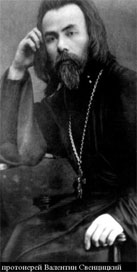 Can inadequacies of individual people sully the holiness of the Church?
A partial answer to that question was given by Archpriest Valentin Sventsitsky (1882-1931), a remarkable pastor and confessor, who suffered a great deal at the hands of the atheist regime. The following is an excerpt from a homily given by Fr. Valentin in the 1920s, during an awful time of persecution against the Russian Church:
Inadequacies in the Church are not just a contemporary manifestation; they have always existed.
It is enough but to recall the words of St. Gregory the Theologian, ‘Faith in God has perished.' It is enough but to recall the words of St. John Chrysostom, who in a talk on the Epistle to the Corinthians said, ‘In the Church, we only have a plethora of fond memories that both in times past and now people would gather together to chant. However, before, when people gathered together to chant, there was oneness of mind, while now you would be hard put to find even one person who would be of one mind with you.'
And this used to be said then, at a time when some of the Nicene Fathers were still alive, when Athanasios the Great had just reposed, when Basil the Great, Gregory the Theologian, and John Chrysostom were alive.
But what does this mean?
It means only that as the result of human weaknesses and illnesses, the Church on earth has many inadequacies.
Can transgressions of individual people shake the holiness of the Church? What a temptation, what a great misunderstanding is expressed if I should leave the Church because I have encountered an unworthy pastor, if I should no longer believe in the Church because one or another bearer of grace has made a bad personal impression on me.
The holiness of the Church does not rest in that. It rests in the Mysteries, in the holiness of God's Grace, in all of the good which that Grace has done for men's souls; it rests in that assembly of saints who were saved by that grace, it rests in every truly kind impulse of our souls.
These glorious and holy [things] are what comprise the holiness of the Church. Our sins – our illnesses – are sinful weaknesses that we wash and cleanse in that Holy Church of Christ.
For that reason, let us not be troubled in our personal life by the evil idea that we need not labour when we are weakened by our sins, and likewise let us not, let our faith not, be troubled by doubts in the holiness of the Church whenever we see some inadequacy or other in the earthly Church.
Our recognition of our sins should evoke in us not despondency, but only ever greater effort to do the Lord's work. Recognition of inadequacies in church life should bring about not estrangement from the Holy Church, but even greater love for it, and a desire to serve for the good of the Church.
Archpriest Valentin Sventsitsky
Link to original
Can inadequacies of individual people sully the holiness of the Church?
A partial answer to that question was given by Archpriest Valentin Sventsitsky (1882-1931), a remarkable pastor and confessor, who suffered a great deal at the hands of the atheist regime. The following is an excerpt from a homily given by Fr. Valentin in the 1920s, during an awful time of persecution against the Russian Church:
Inadequacies in the Church are not just a contemporary manifestation; they have always existed.
It is enough but to recall the words of St. Gregory the Theologian, ‘Faith in God has perished.' It is enough but to recall the words of St. John Chrysostom, who in a talk on the Epistle to the Corinthians said, ‘In the Church, we only have a plethora of fond memories that both in times past and now people would gather together to chant. However, before, when people gathered together to chant, there was oneness of mind, while now you would be hard put to find even one person who would be of one mind with you.'
And this used to be said then, at a time when some of the Nicene Fathers were still alive, when Athanasios the Great had just reposed, when Basil the Great, Gregory the Theologian, and John Chrysostom were alive.
But what does this mean?
It means only that as the result of human weaknesses and illnesses, the Church on earth has many inadequacies.
Can transgressions of individual people shake the holiness of the Church? What a temptation, what a great misunderstanding is expressed if I should leave the Church because I have encountered an unworthy pastor, if I should no longer believe in the Church because one or another bearer of grace has made a bad personal impression on me.
The holiness of the Church does not rest in that. It rests in the Mysteries, in the holiness of God's Grace, in all of the good which that Grace has done for men's souls; it rests in that assembly of saints who were saved by that grace, it rests in every truly kind impulse of our souls.
These glorious and holy [things] are what comprise the holiness of the Church. Our sins – our illnesses – are sinful weaknesses that we wash and cleanse in that Holy Church of Christ.
For that reason, let us not be troubled in our personal life by the evil idea that we need not labour when we are weakened by our sins, and likewise let us not, let our faith not, be troubled by doubts in the holiness of the Church whenever we see some inadequacy or other in the earthly Church.
Our recognition of our sins should evoke in us not despondency, but only ever greater effort to do the Lord's work. Recognition of inadequacies in church life should bring about not estrangement from the Holy Church, but even greater love for it, and a desire to serve for the good of the Church.
Archpriest Valentin Sventsitsky
Link to original
2007-12-24
Images from Antioch
Thanks to Father John Fenton for highlighting this beautiful video of images from the Greek Orthodox Patriarchate of Antioch. (Antioch, the city where "the disciples were first named Christians" - Acts 11:26)
2007-11-24
A Prayer of St Philaret of Moscow
 Lord, I do not know what to beg of Thee; Thou alone knowest what is needful for me. Thou lovest me more than I know how to love Thee.
O Father, give to Thy slave that for which I do not know how to beg. I do not dare to ask for either a cross or a consolation; I am only standing before Thee with my heart open to Thee. Thou seest my needs which I do not even know; see and deal with me according to Thy mercy. Purge and heal me, humble and raise me; I am in awe before Thee and I am silent before Thy will and Thine unfathomable ways for me.
I bring myself as a sacrifice to Thee. Teach me to pray. Pray Thyself within me.
Amen.
(In giving spiritual instruction, Elder Michael of Valaam used to order that this prayer of St Philaret, Metropolitan of Moscow, be prayed every day.)
Lord, I do not know what to beg of Thee; Thou alone knowest what is needful for me. Thou lovest me more than I know how to love Thee.
O Father, give to Thy slave that for which I do not know how to beg. I do not dare to ask for either a cross or a consolation; I am only standing before Thee with my heart open to Thee. Thou seest my needs which I do not even know; see and deal with me according to Thy mercy. Purge and heal me, humble and raise me; I am in awe before Thee and I am silent before Thy will and Thine unfathomable ways for me.
I bring myself as a sacrifice to Thee. Teach me to pray. Pray Thyself within me.
Amen.
(In giving spiritual instruction, Elder Michael of Valaam used to order that this prayer of St Philaret, Metropolitan of Moscow, be prayed every day.)
2007-10-16
Dr Nikolai Khokhlov - In Memoriam
On September 4, 2007 [Old Style], Dr Nikolai Evgenievich Khokhlov, 84, died of a heart attack.
A former officer of the Soviet NKVD (KGB), Professor Khokhlov defected to the West in 1954, after refusing to carry out the assassination of a prominent anti-communist leader in West Germany. He was one of the first high-ranking Soviet intelligence agents to defect to the West, and his story was splashed, at the time, across major American magazines: Newsweek (31 May 1954), Time (3 May 1954), etc.
In the atmosphere of the Cold War, Professor Khokhlov was at once a hero and the subject of suspicion among anti-communist Russian exiles and in Western press reports. This fact and the disappearance (at KGB orders, as he later learned) of his wife, who was pregnant with a son - now a prominent Russian academic - whom he did not know about until after the USSR's collapse, caused him great bitterness throughout his life. The story of his escape to the West is the subject of the book In the Name of Conscience (New York: David McKay, 1959) and a documentary, by the BBC and Russian Public Television, entitled "A Matter of Conscience."
Following his defection, Dr Khokhlov collaborated and worked with Western intelligence services, the US government and various anti-communist activists. As a result, in 1957, in Frankfurt, Germany, he was the victim of an assassination attempt by the KGB, which poisoned him with radioactive thallium (see a recent account of this in the London Times, December 1, 2006.) He quite fortunately survived the attempt, despite a long period of difficult recuperation and rehabilitation.
A brilliant statistician and computer engineer, on settling in the US, Khokhlov pursued graduate schooling in psychology, completing a doctoral degree (in two years) in clinical and experimental psychology at Duke University. He also did extensive work in the field of parapsychology. In 1968, he began a teaching career in psychology at the California State University. An intensely private man, he eventually remarried and had two daughters and a son. (His son died of kidney failure in his youth, and there have long been largely quiet and unconfirmed suspicions, in intelligence circles, that his illness was also initiated by some sort of poisoning - revenge for the failed attempt to poison his father.)
When he was named an emeritus professor at the California State University, Dr Khokhlov was given the following accolade, which perfectly summarizes him: "That so few people are aware of the scope of his international reputation and his intensely personal life struggle, following his defection from the Soviet Union in 1954, is a testimony to his quiet humility ... [and] his 'old world' European Russian gentility."
вечная память! May his memory be eternal!
(Adapted from Orthodox Tradition - Volume XXIV, Number 3 (2007))
2007-04-20
Glorification of St Xenia (1978)
TWO saints in this wonderful old video: St Xenia, of course, and - God willing - St Philaret, too!
2007-04-08
Pascha!
Now let the heavens be joyful.
Let earth her song begin:
Let the round world keep triumph.
And all that is therein:
Invisible and visible.
Their notes let all things blend.
For Christ the Lord is risen
Our joy that hath no end.
(St John of Damascus)
2007-04-06
Good Friday
What Killed Jesus?
An excellent - but gruesome - account on Mike Aqulina's "The Way of the Fathers" blog of the forensic details of Our Lord's Passion and Crucifixion. Some excerpts:
The Gospels say little about the business of crucifixion. “And they crucified him” is all St. Mark offers (15:24), with no word of how it was done or how the cross tortured its victim.
The early Christians offered little more when they recited the Creed: “He was crucified under Pontius Pilate, suffered, died and was buried.”
The Crucifixion comes at the climax of the Christian drama. Yet tradition records the matter as little more than a fact. “They crucified him.” “He was crucified.” History provides no coroner’s report, no painstaking medical reconstruction.
Perhaps our first Christian ancestors could not bear to say any more. They had seen men crucified. They could walk to the outskirts of town if they wanted to count the cost — in blood and pain and humiliation — of their salvation.
Unlike Christians through most of history, we today have not grown up with the experience of public executions and public torture. Still, like the family of any murder victim, we feel the need to know the truth about our Savior and brother — not least because we believe He died for our sake.
Over the past 20 years, a friend of mine, Pittsburgh surgeon Jack McKeating, has applied his professional skills to this problem — reviewing the historical and archaeological evidence in light of recent medical research. Some years back, I interviewed him on the subject for Our Sunday Visitor newspaper.
“Any serious Christian has to take an active interest in the passion of Jesus Christ,” McKeating told me. “Unfortunately, we’re often too dispassionate about it. We tend to think of it in unreal terms, as an abstraction. But it involved a real person who underwent an absolutely brutal experience out of love for me.”
...
Forensic scientists say that the better we know what killed someone, the more likely we are to find out who killed him.
Who killed Jesus? After a decade-and-a-half of study, McKeating doesn’t hesitate to respond.
“I did,” he said. “My sins did.”
2007-03-23
2007-02-19
Great Lent
The Fast has come, mother of chastity, accuser of sins, advocate of repentance, life of the angels and salvation of men. Let us cry out, ye faithful: O God, have mercy on us.
(Aposticha for Matins of the Monday in the First Week)
2007-01-07

2006-12-03
Lutheran Pastor's Resignation Letter
Statement of Resignation
John W. Fenton, for 16 years a Lutheran pastor, most recently at Detroit's Zion Evangelical-Lutheran Church (The Lutheran Church—Missouri Synod), and author of the Conversi ad Dominum blog (highly valued by yrs truly), recently announced his resignation and his entry into the Orthodox Church. Interesting reading.
2006-11-24
St Victor
In honour/celebration of my Name Day (11/24 November) and my heavenly patron, an icon and a life of St Victor of Damascus:
 The Holy Martyr Victor was a soldier during the reign of the emperor Marcus Aurelius (161-180). When the emperor began a persecution against Christians, Victor refused to offer sacrifice to the pagan gods. Such obligatory sacrifices were a test of a soldier's loyalty to the gods, the emperor and the state. The saint was given over to torture, but he survived all the torments unharmed. By the power of prayer he was victorious over a sorcerer, who from that point gave up give sorcery and became a Christian.
Through St Victor's prayers, blind soldiers suddenly received their sight. Witnessing the miracle worked by the Lord through St Victor, Stephanida, the young Christian wife of one of the torturers, openly glorified Christ, for which she was condemned to a cruel death. She was tied to two palm trees bent to the ground, which when released, sprung back and tore her apart. She was fifteen years old.
The torturer ordered that the holy Martyr Victor be beheaded. Hearing the commander's order, St Victor told his executioners that they would all die in twelve days, and that the commander would be captured by the enemy in twenty-four days. As he foretold, so it came to pass.
The martyrs suffered in the second century at Damascus, where their venerable relics were buried.
The Holy Martyr Victor was a soldier during the reign of the emperor Marcus Aurelius (161-180). When the emperor began a persecution against Christians, Victor refused to offer sacrifice to the pagan gods. Such obligatory sacrifices were a test of a soldier's loyalty to the gods, the emperor and the state. The saint was given over to torture, but he survived all the torments unharmed. By the power of prayer he was victorious over a sorcerer, who from that point gave up give sorcery and became a Christian.
Through St Victor's prayers, blind soldiers suddenly received their sight. Witnessing the miracle worked by the Lord through St Victor, Stephanida, the young Christian wife of one of the torturers, openly glorified Christ, for which she was condemned to a cruel death. She was tied to two palm trees bent to the ground, which when released, sprung back and tore her apart. She was fifteen years old.
The torturer ordered that the holy Martyr Victor be beheaded. Hearing the commander's order, St Victor told his executioners that they would all die in twelve days, and that the commander would be captured by the enemy in twenty-four days. As he foretold, so it came to pass.
The martyrs suffered in the second century at Damascus, where their venerable relics were buried.
 The Holy Martyr Victor was a soldier during the reign of the emperor Marcus Aurelius (161-180). When the emperor began a persecution against Christians, Victor refused to offer sacrifice to the pagan gods. Such obligatory sacrifices were a test of a soldier's loyalty to the gods, the emperor and the state. The saint was given over to torture, but he survived all the torments unharmed. By the power of prayer he was victorious over a sorcerer, who from that point gave up give sorcery and became a Christian.
Through St Victor's prayers, blind soldiers suddenly received their sight. Witnessing the miracle worked by the Lord through St Victor, Stephanida, the young Christian wife of one of the torturers, openly glorified Christ, for which she was condemned to a cruel death. She was tied to two palm trees bent to the ground, which when released, sprung back and tore her apart. She was fifteen years old.
The torturer ordered that the holy Martyr Victor be beheaded. Hearing the commander's order, St Victor told his executioners that they would all die in twelve days, and that the commander would be captured by the enemy in twenty-four days. As he foretold, so it came to pass.
The martyrs suffered in the second century at Damascus, where their venerable relics were buried.
The Holy Martyr Victor was a soldier during the reign of the emperor Marcus Aurelius (161-180). When the emperor began a persecution against Christians, Victor refused to offer sacrifice to the pagan gods. Such obligatory sacrifices were a test of a soldier's loyalty to the gods, the emperor and the state. The saint was given over to torture, but he survived all the torments unharmed. By the power of prayer he was victorious over a sorcerer, who from that point gave up give sorcery and became a Christian.
Through St Victor's prayers, blind soldiers suddenly received their sight. Witnessing the miracle worked by the Lord through St Victor, Stephanida, the young Christian wife of one of the torturers, openly glorified Christ, for which she was condemned to a cruel death. She was tied to two palm trees bent to the ground, which when released, sprung back and tore her apart. She was fifteen years old.
The torturer ordered that the holy Martyr Victor be beheaded. Hearing the commander's order, St Victor told his executioners that they would all die in twelve days, and that the commander would be captured by the enemy in twenty-four days. As he foretold, so it came to pass.
The martyrs suffered in the second century at Damascus, where their venerable relics were buried.
2006-11-20
Presentation of the Theotokos
 21 November.
Today let heaven above greatly rejoice and let the clouds pour down gladness at the mighty acts, exceeding marvellous, of our God. For behold, the Gate that looks towards the east, born according to the promise from a fruitless and barren womb, and dedicated to God as His dwelling, is led today into the temple as an offering without blemish. Let David greatly rejoice, striking his harp. "Virgins," said he, "shall be brought to the King after her, her companions shall be brought unto Thee. Within the tabernacle of God, within His place of propitiation, she shall be brought up, to become the dwelling place of Him who was begotten of the Father without change before all ages, for the salvation of our souls." (From the Lity.)
2006-09-14
Feast of the Exaltation of the Holy Cross
O Cross of Christ, immortal tree
On which our Saviour died,
The world is sheltered by your arms
That bore the Crucified.
From bitter death and barren wood
The tree of life is made;
Its branches bear unfailing fruit
And leaves that never fade.
O faithful Cross, you stand unmoved
While ages run their course;
Foundation of the universe,
Creation's binding force.
Give glory to the risen Christ
And to his Cross give praise,
The sign of God's unfathomed love,
The hope of all our days.
- Divine Office: Hymn for 14 September
2006-09-08
Nativity of the Blessed Virgin Mary
From Abbot Gueranger's The Liturgical Year:
"'Let us celebrate the Nativity of the Virgin Mary; let us adore her Son, Christ our Lord.' Such is the invitation addressed to us today by the Church. Let us hearken to her call; let us enter into her ever-flowing joy. The Bridegroom is at hand, for His throne is now set up on earth...
"Andrew of Crete calls this day a solemnity of entrance, a feast of beginning, whose end is the union of the Word with our flesh; a virginal feast, full of joy and confidence for all. 'All ye nations, come hither,' cries St John Damascene; 'come every race and tongue, every age and dignity, let us joyfully celebrate the birthday of the world's gladness.' 'It is the beginning of salvation, the origin of every feast,' says St Peter Damian; 'for behold! the Mother of the Bridegroom is born. With good reason does the whole world rejoice today; and the Church, beside herself, bids her choirs sing wedding songs.'
"Not only do the Doctors of the east and west use similar language in praise of Mary's birth, but moreover the Latin and Greek Churches sing, each in its own tongue, the same beautiful formula, to close the office of the feast:
"'Thy birth, O Virgin Mother of God, brought joy to the whole world: for out of thee arose the Sun of justice, Christ our God: who, taking off the curse, hath bestowed blessing; and defeating death, hath given us life everlasting.'"
2006-08-25
The filioque
I've recently heard (and read) a couple of sermons and statements from Catholic priests that have made me reconsider the importance and implications of the filioque. Bottom line: St Photios may have been more right than I had thought! One sermon, in fact, characterized the Holy Spirit as the "child" proceeding from the mutual love of the Father and the Son. Gulp. Is that an accurate reflection of Catholic theology?!? Sure doesn't sound right to me ... instead of three equal eternal Persons we seem to be introducing a distinct hierarchy into the internal life of the Trinity here ... but what do I know? So ... off to re-read On The Mystagogy of the Holy Spirit. Etc. More later I'm sure.
Subscribe to:
Posts (Atom)