Beautiful paintings of the Tuscan countryside ... by Teri McDonald (September 2007)
2007-10-26


2007-10-20
How TV Affects Your Brain Chemistry
Link to Dr Mercola's article
Groucho Marx: "Television is very educational. Whenever someone turns it on, I go in the other room and read a book."
2007-10-16
Dr Nikolai Khokhlov - In Memoriam
On September 4, 2007 [Old Style], Dr Nikolai Evgenievich Khokhlov, 84, died of a heart attack.
A former officer of the Soviet NKVD (KGB), Professor Khokhlov defected to the West in 1954, after refusing to carry out the assassination of a prominent anti-communist leader in West Germany. He was one of the first high-ranking Soviet intelligence agents to defect to the West, and his story was splashed, at the time, across major American magazines: Newsweek (31 May 1954), Time (3 May 1954), etc.
In the atmosphere of the Cold War, Professor Khokhlov was at once a hero and the subject of suspicion among anti-communist Russian exiles and in Western press reports. This fact and the disappearance (at KGB orders, as he later learned) of his wife, who was pregnant with a son - now a prominent Russian academic - whom he did not know about until after the USSR's collapse, caused him great bitterness throughout his life. The story of his escape to the West is the subject of the book In the Name of Conscience (New York: David McKay, 1959) and a documentary, by the BBC and Russian Public Television, entitled "A Matter of Conscience."
Following his defection, Dr Khokhlov collaborated and worked with Western intelligence services, the US government and various anti-communist activists. As a result, in 1957, in Frankfurt, Germany, he was the victim of an assassination attempt by the KGB, which poisoned him with radioactive thallium (see a recent account of this in the London Times, December 1, 2006.) He quite fortunately survived the attempt, despite a long period of difficult recuperation and rehabilitation.
A brilliant statistician and computer engineer, on settling in the US, Khokhlov pursued graduate schooling in psychology, completing a doctoral degree (in two years) in clinical and experimental psychology at Duke University. He also did extensive work in the field of parapsychology. In 1968, he began a teaching career in psychology at the California State University. An intensely private man, he eventually remarried and had two daughters and a son. (His son died of kidney failure in his youth, and there have long been largely quiet and unconfirmed suspicions, in intelligence circles, that his illness was also initiated by some sort of poisoning - revenge for the failed attempt to poison his father.)
When he was named an emeritus professor at the California State University, Dr Khokhlov was given the following accolade, which perfectly summarizes him: "That so few people are aware of the scope of his international reputation and his intensely personal life struggle, following his defection from the Soviet Union in 1954, is a testimony to his quiet humility ... [and] his 'old world' European Russian gentility."
вечная память! May his memory be eternal!
(Adapted from Orthodox Tradition - Volume XXIV, Number 3 (2007))
2007-09-16
2007-09-13
My Title
 | My Peculiar Aristocratic Title is: The Most Honourable Victor the Confused of Withering Glance Get your Peculiar Aristocratic Title |
2007-09-06
2007-04-20
Glorification of St Xenia (1978)
TWO saints in this wonderful old video: St Xenia, of course, and - God willing - St Philaret, too!
2007-04-08
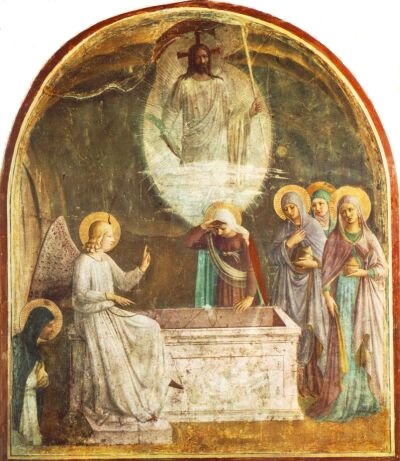
Pascha!
Now let the heavens be joyful.
Let earth her song begin:
Let the round world keep triumph.
And all that is therein:
Invisible and visible.
Their notes let all things blend.
For Christ the Lord is risen
Our joy that hath no end.
(St John of Damascus)
2007-04-06
Good Friday
What Killed Jesus?
An excellent - but gruesome - account on Mike Aqulina's "The Way of the Fathers" blog of the forensic details of Our Lord's Passion and Crucifixion. Some excerpts:
The Gospels say little about the business of crucifixion. “And they crucified him” is all St. Mark offers (15:24), with no word of how it was done or how the cross tortured its victim.
The early Christians offered little more when they recited the Creed: “He was crucified under Pontius Pilate, suffered, died and was buried.”
The Crucifixion comes at the climax of the Christian drama. Yet tradition records the matter as little more than a fact. “They crucified him.” “He was crucified.” History provides no coroner’s report, no painstaking medical reconstruction.
Perhaps our first Christian ancestors could not bear to say any more. They had seen men crucified. They could walk to the outskirts of town if they wanted to count the cost — in blood and pain and humiliation — of their salvation.
Unlike Christians through most of history, we today have not grown up with the experience of public executions and public torture. Still, like the family of any murder victim, we feel the need to know the truth about our Savior and brother — not least because we believe He died for our sake.
Over the past 20 years, a friend of mine, Pittsburgh surgeon Jack McKeating, has applied his professional skills to this problem — reviewing the historical and archaeological evidence in light of recent medical research. Some years back, I interviewed him on the subject for Our Sunday Visitor newspaper.
“Any serious Christian has to take an active interest in the passion of Jesus Christ,” McKeating told me. “Unfortunately, we’re often too dispassionate about it. We tend to think of it in unreal terms, as an abstraction. But it involved a real person who underwent an absolutely brutal experience out of love for me.”
...
Forensic scientists say that the better we know what killed someone, the more likely we are to find out who killed him.
Who killed Jesus? After a decade-and-a-half of study, McKeating doesn’t hesitate to respond.
“I did,” he said. “My sins did.”
Subscribe to:
Posts (Atom)